Mostar Attractions · 16 min read
Things to Do in Mostar — A Local's Complete Guide for 2026
20 things to do in Mostar from a local guide: Stari Most, bridge divers, Old Bazaar, Fortica Sky Walk, Buna Spring, Kravica day trip. Maps, prices, opening hours, and what to skip.
Quick answer
20 things to do in Mostar from a local guide: Stari Most, bridge divers, Old Bazaar, Fortica Sky Walk, Buna Spring, Kravica day trip. Maps, prices, opening hours, and what to skip.
Quick answer — top 5 things to do in Mostar
If you only have a few hours:
- Walk Stari Most — the 1566 Ottoman bridge, rebuilt 2004, UNESCO listed
- Watch the bridge divers — daily in summer; donations expected (€2–5 typical)
- Climb the Koski Mehmed Pasha Mosque minaret — best photo of the bridge from above (€6 entry)
- Walk Kujundžiluk (Coppersmith Street) — the Ottoman-era bazaar
- Take the Fortica Sky Walk — free 35-metre glass platform 500 m above the Old Town
If you have a full day, add one of these:
- Day trip to Kravica Waterfall — Bosnia’s largest waterfall, swim June–September
- Half-day to Blagaj Tekija + Buna Spring — 600-year-old Sufi dervish house at the source of an emerald river
- Pocitelj fortress — Ottoman fortress town 30 min south of Mostar
Below is the full 20-item guide, organized by what kind of traveler you are.
What makes Mostar different
Mostar (population ~110,000) is the largest city in Herzegovina, the southern half of Bosnia and Herzegovina. It sits in the narrow Neretva river valley between the Velež and Hum mountains, about 130 km from the Adriatic coast.
The city is famous for one thing — Stari Most (the Old Bridge), the 16th-century Ottoman stone bridge that gives Mostar its name (mostari = bridge keepers). The original bridge stood for 427 years before being destroyed by shelling on 9 November 1993 during the Croat-Bosniak war. It was painstakingly rebuilt using original stones recovered from the riverbed plus local Tenelija limestone, and reopened on 23 July 2004. The bridge and surrounding Old Town joined the UNESCO World Heritage List in 2005.
Beyond the bridge, Mostar offers Ottoman bazaars, Austro-Hungarian boulevards, war-history museums, swim spots in the Buna and Trebižat rivers, mountain hikes, and the Sufi dervish heritage at Blagaj. It’s compact (you can walk the whole Old Town in 2 hours), heavy on history, and surprisingly easy to combine with day trips to Croatia and Montenegro.
Old Town: the historic core (1–6)
1. Stari Most — the Old Bridge
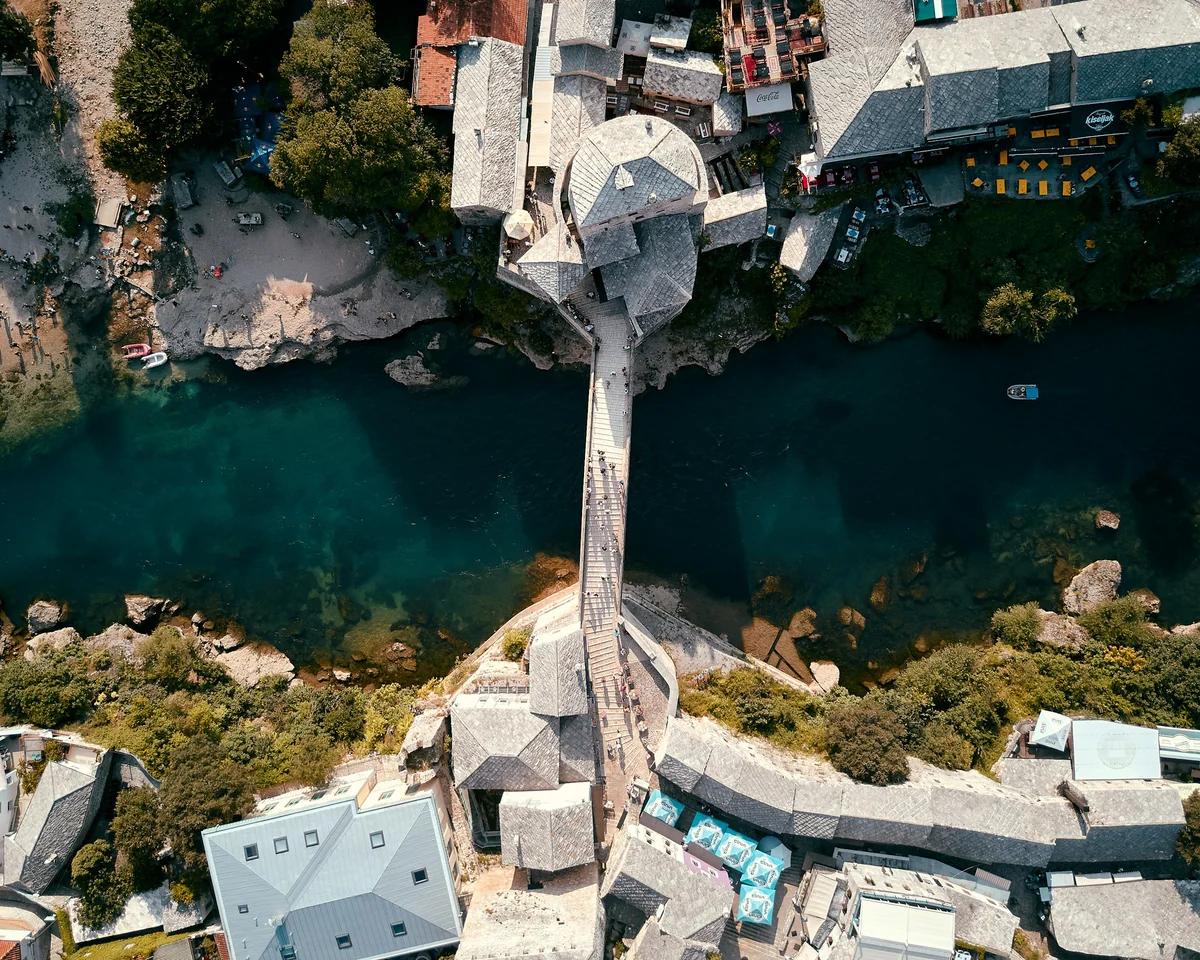
The single most-visited landmark in Bosnia and Herzegovina. The arch spans 30 m and rises 20 m above the Neretva river. Walking it is free and crowded mid-day; the best photos are at sunrise or just after sunset when the lights come on.
Tip: the cobblestones are smooth and slippery in rain. Hold the railings if you’re walking it in summer flip-flops.
Dive deep on history, architecture, and visiting tips in our Stari Most complete guide.
2. The bridge divers
The bridge divers club (Mostari) jumps from the 24-metre-high parapet daily in summer, performing for tips. The first official dives took place in 1664; the practice never stopped except during the Yugoslav wars.
Standard dives are €2–5 in tips per group of viewers. The “official” jumps (where divers wait for a crowd to gather) happen most reliably 11:00–14:00 in July and August. Smaller spontaneous dives happen throughout the day.
You can also pay to do a training jump yourself at the divers’ club — €25 trains you in the technique, then a €25 ceremony fee gets you the jump. Real qualification takes weeks.
Full details on timing, jumping yourself, and best viewing spots: Stari Most divers guide.
3. Kujundžiluk (Old Bazaar / Coppersmith Street)
The cobblestone Ottoman bazaar street running east of Stari Most. Originally the workshops of Mostar’s coppersmiths (kujundžije), now mostly tourist shops selling copper coffee sets, scarves, jewelry, and rakija.
Real artisans still work in 2-3 of the shops — listen for the hammering. Real Bosnian copper is hammered from a single sheet (you’ll see the hammer marks); machine-made knock-offs are smooth.
What to buy: a džezva (Bosnian coffee pot) is the iconic souvenir — €15-30 for a real hand-hammered one; cheap machine ones go for €5-10. Fridge magnets are everywhere; rakija and ajvar are heavy and ship poorly.
4. Koski Mehmed Pasha Mosque + minaret view
Built in 1617, located on the east bank of the Neretva right next to Stari Most. Open to non-Muslim visitors outside prayer times; modest dress required (women should cover hair, men should wear long trousers — scarves and wraps available at the entrance).
The reason most tourists come: you can climb the minaret. The view from the top is the single best Stari Most photo angle — bridge below, Old Town stretching east, Neretva river running south. The climb is 89 narrow stone steps in a tight spiral; not for the claustrophobic.
Entry: €3 mosque only, €6 mosque + minaret. Open 9:00–20:00 in summer, shorter winter hours.
5. Kriva Ćuprija (Crooked Bridge)
The little arched stone bridge crossing the Radobolja stream just west of Stari Most, built in 1558 — eight years before Stari Most. It’s the original “small Stari Most” — the architects practiced the stone arch technique here before scaling up. Less crowded, very photogenic in evening light.
6. Karadjozbeg Mosque
Built in 1557, the largest and oldest mosque in Mostar. North of the Old Bazaar, off the main tourist trail — most day-trippers skip it. Beautiful interior with original 16th-century painted ceiling. Entry €2.
Karadjozbeg Mosque guide (note: this entity covers both Karadjozbeg in Mostar and Gazi Husrev Beg in Sarajevo).
Beyond the bridge: viewpoints and adventure (7–11)
7. Fortica Sky Walk
Opened 2023. A 35-metre glass-floor platform built into the side of the Austro-Hungarian fortress on the eastern hill, 500 m above the Old Town. Walking the platform is completely free — you only pay for adventure-park activities (zip line, climbing, swing) if you want them.
The view: the entire Old Town, Stari Most, the Neretva valley laid out below your feet. Sunset is the most-photographed time.
How to get there:
- Self-drive: 15 min from Old Town, free parking at top
- Taxi: €8-12 each way
- Hike: 45 min uphill from Old Town
- Our Fortica shuttle: €8 round-trip, hourly hop-on-hop-off May–October
- For sunset visits, see our Fortica Sky Walk guide — or WhatsApp +387 61 209 388 for a private sunset transfer (from €40/vehicle)
Full prices for adventure activities + complete visiting guide: Fortica Sky Walk Mostar.
8. Hum Hill + Millennium Cross
The cross-topped hill on the western side of the city, 436 m elevation. The Mostar Millennium Cross was erected in 2002. A 1-hour hike from the Spanish Square brings you to the summit — best panorama of the entire valley including Stari Most below.
Note: the trail passes a few areas with old landmine warning signs from the 1990s. Stay on marked paths. Don’t walk this alone if you’re not confident — go with a guided tour.
9. Mostar Boat Tour
Short 15-minute boat ride on the Neretva — you launch from below Stari Most and float downstream around the bend, then motor back. €5–10 per person depending on season. Best at golden hour.
Boats wait below the bridge on the west bank — no booking needed, just walk down.
10. War Photo Exhibition (House of Photography)
Permanent exhibition of war photography by Wade Goddard, an embedded photojournalist during the Bosnian war. Located in the Old Bazaar near Stari Most. One of the most affecting things you can do in Mostar — a sobering counterweight to the Old Town’s pretty surface.
Entry €4. Allow 30-45 minutes. Open 10:00-19:00 in summer.
11. Bunski Kanali — the Buna river canyon
Five minutes off the M17 highway, halfway between Mostar and Blagaj. The confluence of the Buna and Neretva rivers, with shallow pools, picnic-friendly riverbanks, and a small waterfall. Almost no tourists know about it — it’s the local Mostar swim spot. Free to visit.
Restaurants on the riverbank serve trout grilled on the open fire — €15-20 for a whole fish with sides.
Food, museums and culture (12–15)
12. Try real Bosnian food (skip the tourist traps)
The Old Bazaar has 20+ restaurants but most are 30-50% pricier than equivalent local places, and quality is mid. Eat at:
- Hindin Han — Old Town location but family-run, decent prices, real Bosnian
- Tima-Irma — burek and pita the way locals make them, walk 5 min north of Old Town
- Restoran Šadrvan — actually IN the Old Bazaar but the most consistently good of the touristy ones
- Restoran Lebsko — across the river west bank, 10 min walk from Stari Most, no tourists
Try: ćevapi (grilled minced beef sausages with onions and somun bread, €5-8), burek (meat-filled hand-rolled filo, €3-5), dolma, sogan-dolma (stuffed onions, regional specialty), tufahija (poached apple with walnuts, dessert).
Full list with prices and locations: Best restaurants in Mostar.
13. Tepa farmers’ market
Open 7:00–14:00 every day except Sunday. Located right next to the Koski Mehmed Pasha Mosque courtyard. Local fruit, vegetables, honey, kajmak (clotted cream), ajvar (red pepper relish), figs in season.
Best buys: dried figs, walnuts, lavender honey, homemade ajvar in jars (~€5-8 per jar).
14. Bosnian cooking class
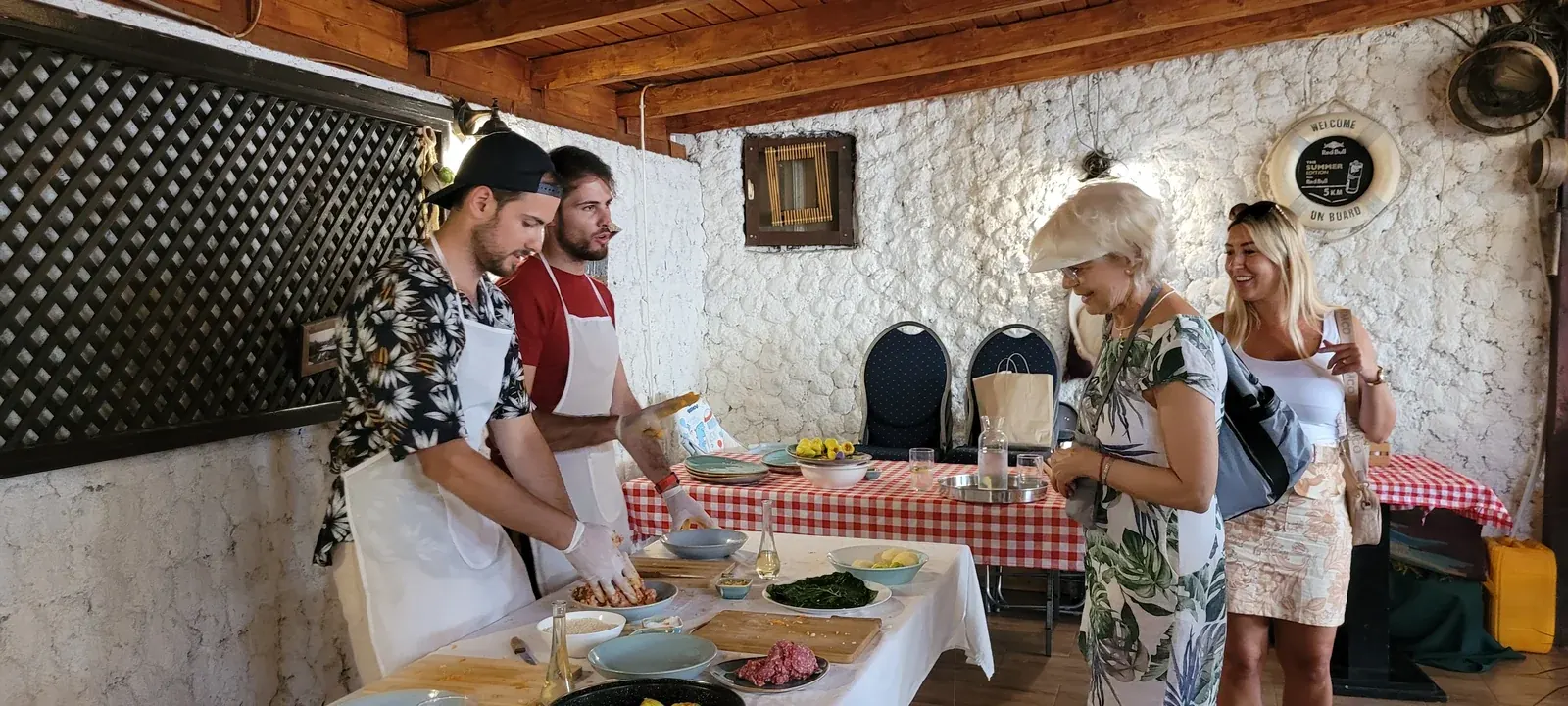
Hands-on traditional cooking experience. The flagship product on TripAdvisor (Food House Mostar runs the only major class with 200+ reviews; we run our own cooking lessons and burek masterclass for smaller groups).
You’ll learn dolma, sogan-dolma, burek, or pita depending on the class. Includes lunch with what you cooked.
15. War-history walking tour
A guided 2-hour walk covers the war frontline (former Bulevar, the Sniper Tower, the Boulevard’s bombed apartment blocks), the Jasenica neighbourhood, and the city’s reconstruction. Heavier than the standard tourist walk — but the most-recommended thing to do in Mostar after the bridge itself.
Our Mostar walking tour covers the war story alongside Old Town history; ~€25 per person, 2 hours.
For a deeper structured introduction to the city’s complex history, see our Mostar culture guide and Mostar travel guide.
Day trips from Mostar (16–20)
These are half-day or full-day excursions outside the Old Town that most travellers do as add-ons. Listed in order of how often we get asked about them.
16. Kravica Waterfall (45 min south)
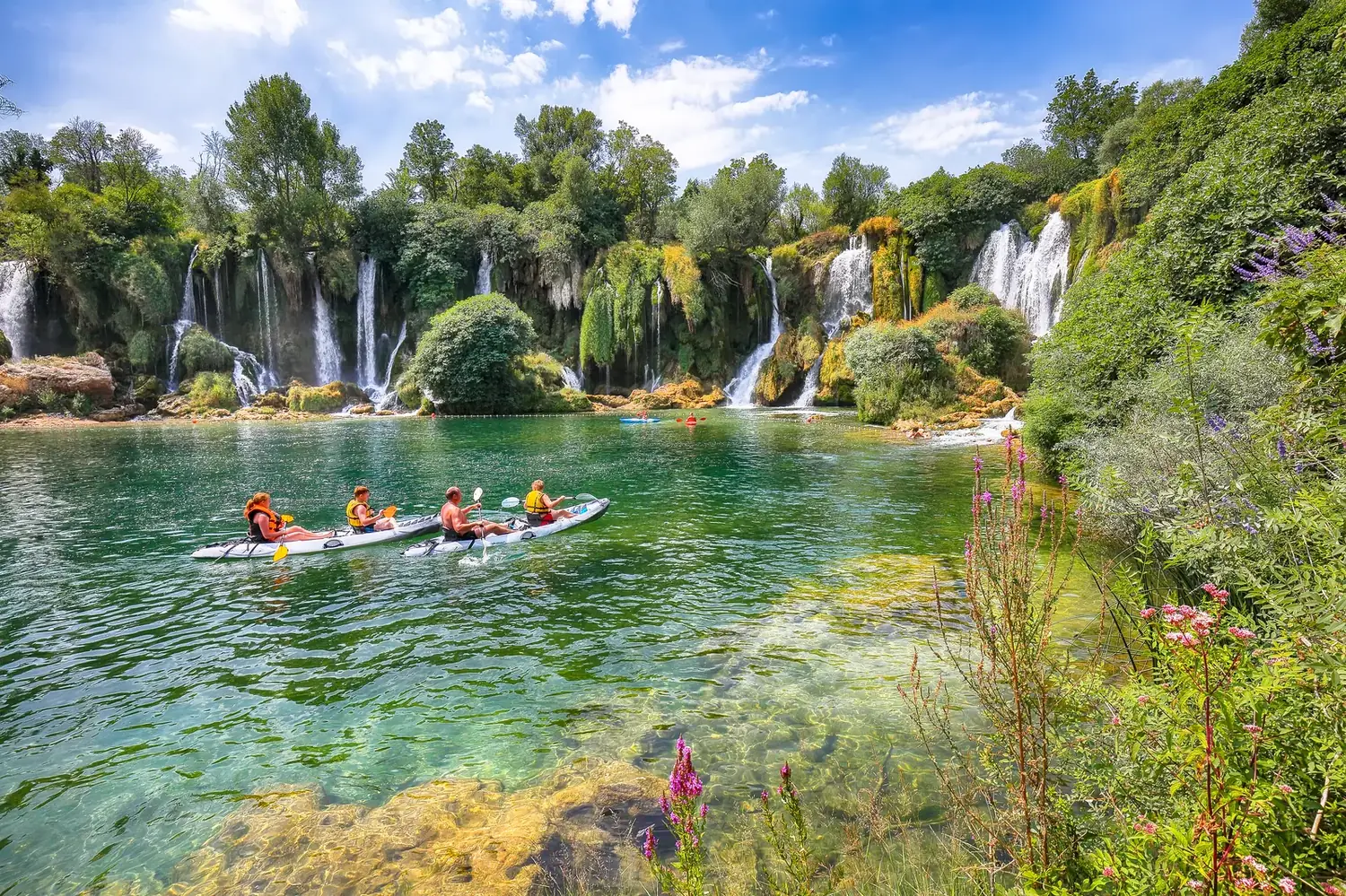
Bosnia’s largest waterfall — 25 m tall, 100 m wide travertine cliff face, swimmable pool at the base. €10 entry April–October, free Nov–March. Open 7:00–22:00 in summer.
Three ways to visit:
- Kravica day tour from Mostar — €50/person, includes Pocitelj and Blagaj, 8h
- Self-drive — 45 min on M17, free parking
- Public bus + taxi — only weekdays, complicated
Full guide: Kravica Waterfall.
17. Blagaj Tekija + Buna Spring
A 600-year-old Sufi dervish house (Tekija) built into the cliff at the source of the Buna spring — one of the largest cold-water springs in Europe. The water emerges from a cave at the base of a 200-metre cliff, blue-green and ice cold. The Tekija is the most photographed building in Bosnia after Stari Most.
15 km south of Mostar, 25 min drive. Entry to Tekija interior: €4. Boat into the cave (summer only): ~€10 ad-hoc booking on the day from riverbank operators.
18. Pocitelj fortress
Ottoman fortress town 30 km south of Mostar, on a steep hillside above the Neretva. UNESCO tentative list. Climb to the top of the fortress for panoramic Neretva valley views. Famous for its pomegranate juice in season (Sep-Oct, €2 per glass at gate stalls).
Free entry. 30 min drive from Mostar. Usually combined with Kravica + Blagaj as the “4 pearls of Herzegovina” day. Full guide: Pocitelj UNESCO, Pocitelj fortress + mosque.
19. Tito’s Bunker (ARK D-0) Konjic
50 km north of Mostar, 1 hour drive. Yugoslavia’s secret nuclear bunker complex built by Tito 1953-1979 — declassified 2011, now open as a museum. Tour goes 280 m deep into the mountain, through 6,500 m² of corridors and rooms, including Tito’s private quarters and the central command room.
Tickets must be booked in advance (limited groups; price set by the operator and changes with the season). Our Tito’s Bunker day tour handles booking + transport (€65/person).
20. Neretva river rafting
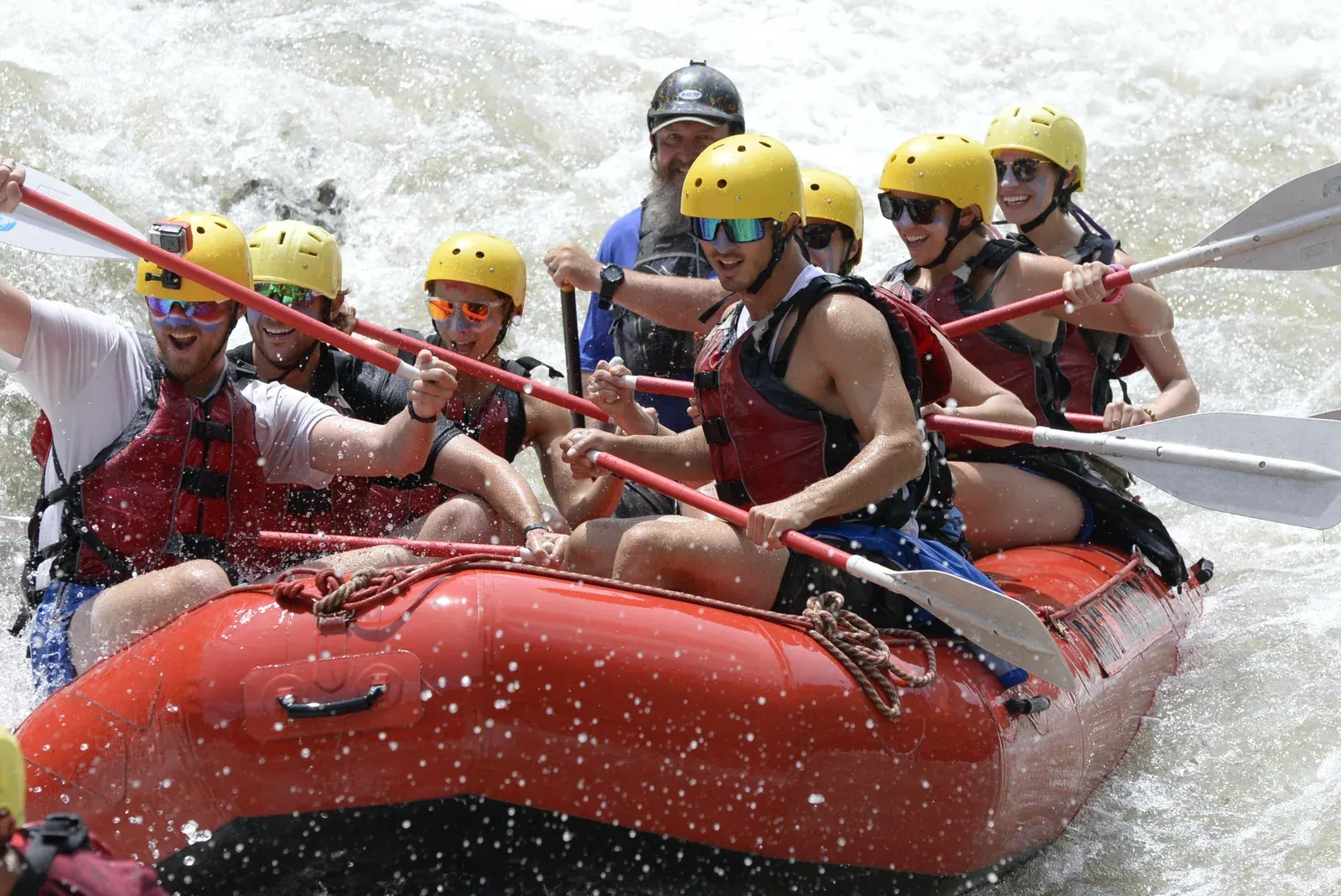
Half-day or full-day rafting on the Neretva from Konjic (1 hour north). Class I-III (suitable for first-timers). Cold water (12-14 °C even in August), thermal wetsuits provided. Full-day trip includes traditional Bosnian breakfast + lunch.
Neretva rafting — €67/person, 8h day. Or our Neretva kayak safari (€35, half-day) and Neretva canyon boat tour (€45, half-day) for slower-paced river experiences.
When to visit Mostar
| Season | Pros | Cons |
|---|---|---|
| Spring (Apr-Jun) | Mild weather (15-25 °C), fewer crowds, all attractions open | Some rain in April |
| Summer (Jul-Aug) | All attractions open, divers active daily, longest daylight | Very hot (38-42 °C), peak crowds, peak prices |
| Autumn (Sep-Oct) | Warm sun, swim still possible, harvest season at vineyards | Days getting shorter |
| Winter (Nov-Mar) | Cheap accommodation, atmospheric, Christmas markets | Some attractions closed; Kravice park free but stripped down; rafting closed |
Sweet spot: late May, June, or late September. Comfortable temperatures, full operations, manageable crowds.
Mostar in winter for cold-season visits.
How long do you need?
| Trip length | What you can fit |
|---|---|
| Half-day (4-6h) | Stari Most, Old Bazaar, one mosque or museum, lunch |
| One day (8-10h) | Add: Fortica Sky Walk OR Blagaj OR Kravice (one of three) |
| Two days | Above + full Herzegovina day (Blagaj + Pocitelj + Kravice) |
| Three days | Add: Konjic (Tito’s Bunker) + rafting OR wine tour OR Velež hike |
| One week | All of above + Sarajevo overnight + Sutjeska or Una national parks |
For day-trip planning from coastal cities, see our day trip from Dubrovnik and day trip from Split guides.
Detailed itineraries: Mostar 1, 2, or 3 days.
Where to stay
The Old Town and immediately surrounding areas have most of the boutique hotels and apartments. Stay east of the river within 5 minutes’ walk of Stari Most for the iconic experience.
For first-timers: any Old Town apartment or small hotel — you’ll walk everywhere.
For families / longer stays: the new town (south of the Old Town) has bigger apartments with parking — you’ll just need to walk 10-15 min to reach the bridge.
For budget travellers: Budget Mostar travel guide.
Solo female travellers: Mostar is among the safest small cities in Europe — see Solo female travel in Mostar.
Mistakes to avoid
- Eating in the loudest Old Bazaar restaurants — they target day-trippers. Walk 5 min outside the bazaar for better food at lower prices.
- Parking in unofficial spots — always blue municipal parking (PayByPhone, ~€1/h) or hotel parking. Unofficial attendants overcharge €5-10.
- Trying to take public bus to Kravice on a weekend — there is no weekend service from Mostar to Capljina. Use a tour or a private transfer.
- Underestimating summer heat — Mostar’s stone valley traps heat. 38-42 °C in July-August is normal. Avoid 12:00-16:00 outdoor walking.
- Booking a Dubrovnik day-trip combo that excludes Kravice entry fee — adds €10/person at the gate. Always check inclusions.
- Wearing flip-flops on Stari Most — the cobblestones are slippery especially in rain. Real shoes only.
- Skipping the War Photo Exhibition — pretty Old Town hides a complex story; the museum is essential context.
For broader practical tips: Mostar travel guide for first-time visitors.
Practical info
- Currency: Convertible Mark (KM, BAM). 1 EUR ≈ 1.96 KM. Many places accept EUR (especially tourist sites). Cards widely accepted in restaurants and bigger shops; cash needed for street food, small shops, parking. ATMs widely available.
- Tap water: safe to drink across Mostar. Mostar tap water guide.
- Language: Bosnian (Croatian + Serbian variants are mutually intelligible). English widely spoken in tourist areas; German and Italian common.
- Getting there: Sarajevo Airport (130 km, 2.5h) or Mostar Airport (limited flights). Train from Sarajevo (2 daily, 2.5h, scenic). Direct bus from Dubrovnik, Split, Sarajevo.
- Getting around: Old Town is walkable. For day trips and airport transfers, we run private transfers from €60.
Visit on a guided tour
We run small-group and private tours from Mostar to all the day-trip destinations above. Pricing is fully transparent (entry fees included, no surprises at the gate).
- Kravica day tour from Mostar — €50 / person, 8h, includes Blagaj + Pocitelj + Kravice + lunch
- Mostar walking tour — 2h Old Town walk with a local historian, €25/person
- Bosnian cooking class — hands-on cooking + lunch, half-day, €60/person
- Burek Masterclass — quick 1h hands-on burek class, €18/person
- Tito’s Bunker Konjic — full day, €65/person
- Neretva rafting — full day, €67/person
- Fortica Sky Walk shuttle — hop-on shuttle, €8/person
- Fortica Sky Walk — free glass platform, golden-hour viewpoint over Mostar Old Town
- Day trip from Dubrovnik — €115/person, 11-12h
- Day trip from Split — €125/person, 12h
- Day trip from Sarajevo — €77/person, 10h
- Private transfer with stops — from €60 / vehicle
For custom multi-stop trips: WhatsApp +387 61 209 388.
FAQ
Frequently asked questions
What are the must-see things in Mostar?
The Big Five: Stari Most (the Old Bridge), the bridge divers, Old Bazaar (Kujundžiluk), Koski Mehmed Pasha Mosque minaret view, and Fortica Sky Walk for the panoramic Old Town shot. Plan one full day for the city; add a second day for Blagaj + Pocitelj + Kravice combo.
How long do you need in Mostar?
Minimum 1 day for the Old Town walk and one viewpoint. 2 days lets you fit the Blagaj + Buna Spring half-day. 3 days gets you the full Herzegovina experience including Kravica Waterfall and Pocitelj. See our [Mostar itinerary](/mostar-itinerary/).
What's the best free thing to do in Mostar?
Walk Stari Most and watch the bridge divers from the riverbank. The Old Bridge is free to cross; the diving show in summer is free to watch. Walking Kujundžiluk bazaar is also free. Most museum interiors charge €3-5. Fortica Sky Walk platform is free (only zip line + climbing have fees).
When was Stari Most built and destroyed?
The original Ottoman bridge was completed in 1566 by architect Mimar Hayruddin. It stood for 427 years before being destroyed by shelling on 9 November 1993 during the Croat-Bosniak war. Reconstruction completed and reopened on 23 July 2004; the bridge was added to the UNESCO World Heritage List in 2005.
Is Mostar worth a day trip from Dubrovnik?
Yes — but only as a full-day (10-12 hours) trip, not a half-day. The drive is 2.5h each way plus border crossing time. Book early-morning departure to maximize Mostar time. See our [day trip from Dubrovnik](/dubrovnik-to-mostar-day-trip/).
What should you skip in Mostar?
Most Old Bazaar restaurants are tourist-priced and average quality. Skip the riverside terraces with the loudest hawkers; eat at family-run places 5-minute walk from the bridge. Skip parking signs that aren't blue municipal parking — unofficial parking attendants overcharge. Skip the public bus to Kravice on weekends (no service).
How hot is Mostar in summer?
Very hot — Mostar's narrow valley traps heat. July and August regularly hit 38-42 °C (100-108 °F). Avoid 12:00-16:00 outdoor walking in peak summer. Spring (May-June) and autumn (September-October) are far more comfortable for sightseeing.